


Where research becomes treatment in real time
Robotic Surgery
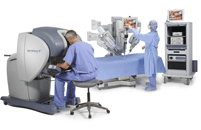
Robotic surgery technique reduces the risks associated with conventional surgery and offers numerous potential benefits to the patient:
- Reduced hospital stay
- Less post-operative pain
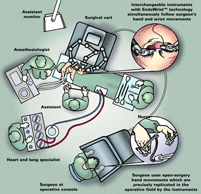
- Reduced risk of infection
- Minor bleeding
- Reduced need for transfusions
- Faster return to all daily normal activities
- Better cosmetic result
The challenge for today’s robotic surgeons is to advance the system through clinical research in such a way that it becomes
suitable and indispensable for future routine applications.
Team Work and Education
The IEO School of Robotic Surgery organized 7 courses in 2013, i.e. five basic courses on thoracic, abdomino-pelvic and minimally invasive, H&N, and gynaecologic oncology robot-assisted surgery, two advanced courses in urology (on robot-assisted prostatectomy and nephrectomy), and one for OR nurses.
IEO collaboratres with the Florida Hospital Nicholson Center, one of the most prestigious international centers of advanced robotic surgery with offices in Celebration and Orlando (FL). The collaboration is organized in the field of Education, Research and Training on Development of Robotic Surgery.
-
UROLOGIC ROBOTIC SURGERY

The IEO Urologic Surgery Division is the National Reference Center for Urologic Robotic Surgery.
The Urologic Surgery division was the first to introduce in IEO the robotic surgery and, since its inception in November 2006, has been made over 2500 surgeries.
Prof. Ottavio de Cobelli, director of the Division, conducts many surgical robotic activities at several Italian hospitals (Cagliari, Brescia, Lecco, Alexandria, Nuoro, San Giovanni Rotondo, Pavia) and foreign hospital (Cluj - Napoca, Bucharest, Romania, Pleven - Bulgaria).
The diseases treated today with robot technology by the IEO Urologic Surgery Division include the prostate cancer and other urological cancers (kidney, adrenal glands and bladder).
-
ABDOMINO-PELVIC ROBOTIC SURGERY
The doctors of the IEO Division of Gastrointestinal Surgery with the Multidisciplinary Surgical Techniques Unit and the Innovative Surgical Techniques Unit were pioneers in the use of Robotic Surgery. This innovative technique that offers numerous potential benefits to the patient is routinely used for the treatment of malignant neoplasms.
The IEO Division of Abdomino-Pelvic Surgery is a reference center at national and European level for Robotic Surgery and works with the most advanced centers in the world for research and development in this field.
The Division of Abdomino-Pelvic Surgery treats the following diseases:
- Colorectal Cancer
- Adrenal Gland Cancer
- Stomach Cancer
- Pancreas Cancer
- Liver Cancer
- Spleen Cancer
-
GYNECOLOGIC ROBOTIC SURGERY
The Robotic Surgery is the most innovative and sophisticated technique of minimally invasive surgery available and its use is indicated in the treatment of most of gynecological malignancies.
The traditional laparoscopic surgery, which typically requires large incisions to access the pelvic cavity, was for many years the standard approach for performing many procedures. However, as is known, the laparotomy is frequently correlated to significantly higher levels of post-operative pain due to the extensive tissue injury. In addition to the "open" approach the recovery time is often prolonged.
Although vaginal surgery and laparoscopic surgery offer many potential benefits to patients compared to laparotomy surgery including a lower incidence of complications, a shorter period of hospital stay and a quicker convalescence, these surgical approaches have still some disadvantages. The vaginal hysterectomy provides extremely reduced workspaces to adequately visualize the organs contained in the pelvis.
Moreover, the presence of a narrow pubic arch, adhesions due to previous surgeries (including caesarean section), severe endometriosis or a tumor that is no longer in its early stage/localized requiring the execution of more extensive procedures and even the removal of lymph nodes, contraindicate vaginal surgical approach.
The Robotic Surgery is the most innovative alternative to both, the traditional laparotomy and the conventional laparoscopic, allowing to perform with extreme accuracy even complex and delicate procedures such as those often required in the treatment of gynecological cancer.
Through small incision of approximately 1-2 cm, the surgeon using the robot is able to operate with an extraordinary precision, minimizing the extent of the pain and the risks associated with large incisions, while ensuring a faster convalescence and a better quality of care.
Robotic Hysterectomy
The robotic surgical approach is indicated for many diseases both benign (myoma, endometriosis, etc.) and malignant (cancers of the uterine cervix, endometrium and, in some cases, even the ovary). The removal of the uterus by robotic surgery offers numerous advantages compared to traditional surgeries, especially in the case of radical hysterectomy (for the presence of cervical neoplasia) and systematic lymphadenectomy in the pelvic and / or aortic
-
THORACIC ROBOTIC SURGERY
Over the past 15 years we have tried to reduce the surgical invasiveness through the use of minimally invasive techniques. One of these approaches is represented by thoracoscopy, which avoids the large incisions and the thoracic rib and is associated with benefits such as less postoperative pain, less immune response, quicker return to daily activities, best functional and aesthetic results and a better quality of life.
The robotic approach using the Da Vinci system represents a very sophisticated technological evolution of the traditional video-thoracoscopy technique.
The advantages of the robot are:
- Magnification of the image due to the 3-D view of the operating field instead of the 2-D
- More accurate movements
- Simplest use of the instruments due to the vast possibilities of angulation inside the chest cavity
The experience gained in this area by our Institute and other international centers of reference shall encourage the development of this innovative and minimally invasive branch of the thoracic surgery.
The staff of the IEO Division of Thoracic Surgery is involved in the scientific activities of several international companies as the EACTS (European Association of Cardiothoracic Surgery), the CRSA (Clinical Robotic Surgical Association) and the ISMICS (International Society of Minimally Invasive Surgery Cardothoracic) for the development and dissemination of robotic surgery.
-
HEAD AND NECK ROBOTIC SURGERY
Robotic surgery represents the most sophisticated and modern mini-invasive technology in the field of head and neck surgery.
The main advantage resides in the fact that it avoids major surgical approaches (known as “transmandibular” approaches) in which there is a high rate of postoperative complications.
In 2006 the European Institute of Oncology introduced the da Vinci surgical device and in July 2007, after practical training, our division performed the first operation: a supraglottic partial laryngectomy. So far we have treated more than 160 patients affected by malignant and benign lesions of the oropharynx and supraglottic larynx. Over the last three years, we have extended our experience, with very positive outcomes, to the treatment of parapharyngeal lesions; this is a very surgically demanding anatomic area due to the presence of vital vessels and nerves.
Transoral Robotic Surgery (also known as TORS) is currently used for the treatment of oropharyngeal, laryngeal and parapharyngeal spase diseases .
The Head and Neck program staff are involved in scientific activities concerning education, training and development in the field of robotic surgery, through close collaboration with several prominent scientific societies, both national (SIO, Italian society of Otolaryngology – AIOOC, Italian Association of Cervico-Facial Oncology) and international (IFHNOS, International Federation of Head Neck Oncologic Societies – EHNS, European Head & Neck Society).
Our Institute every year organize dedicated courses on robotic surgery included TORS.
The chief of the ENT division and of the Head and Neck program, Dr. Mohssen Ansarin, is a founding partner of the SRS (Society of Robotic Surgery).
-
Senology Robotic Surgery
The synergy between robots and doctors is longstanding. Robot-assisted surgery is the latest evolution of minimally invasive surgery: in abdominal-pelvic, especially urology and thoracic procedures this advanced technique has helped doctors to reduce the risks associated with conventional surgery and has several advantages for the patient.
Robotic Surgery for nipple-sparing mastectomy
Robotic surgery is relatively new to the Senology field.
The IEO Senology Program has been one of the first to use this new approach and since 2014 has been investigating the feasibility and safety of a robot-assisted nipple-sparing mastectomy.
PARTNERSHIP

MAIN CREDITS